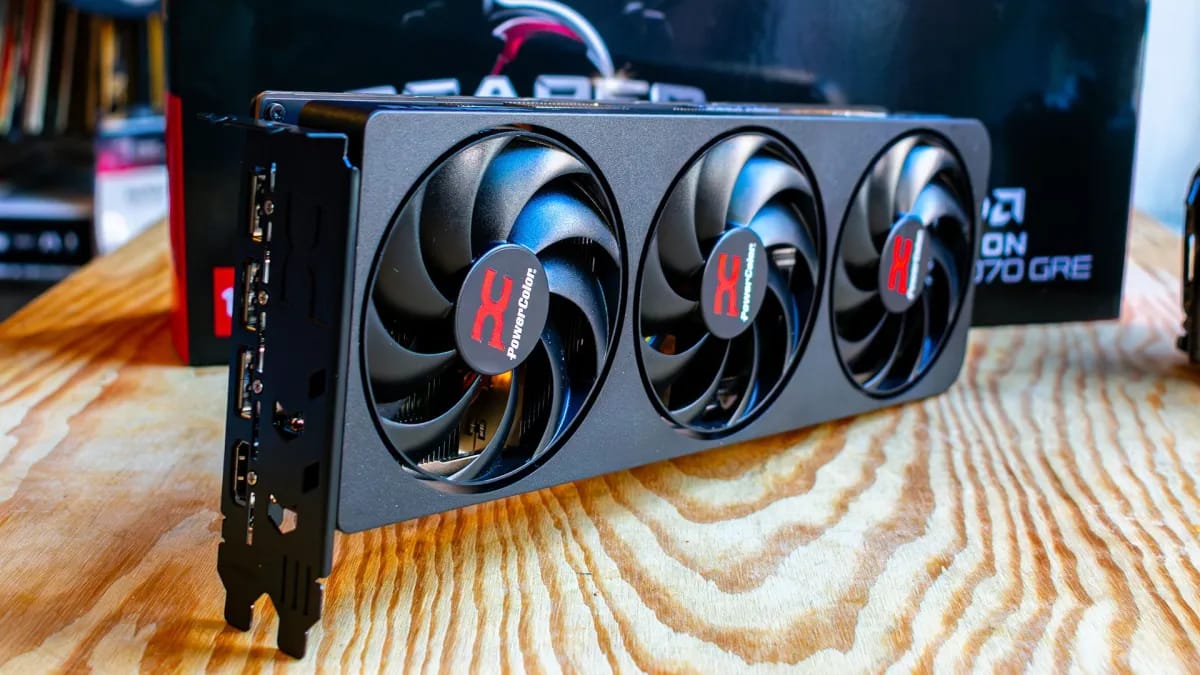
The AMD Radeon RX 9070 GRE launches at $549 — the same price the 7900 GRE debuted at — and slots in exactly between the 9060 XT and the standard 9070 in both price and performance. It's a capable 1440p card, but the value proposition is messier than AMD's previous GRE launches.
On paper, the 9070 GRE is a binned 9070: 48 Compute Units versus the 9070's 56, 3,072 Streaming Multiprocessors, and 12GB of GDDR6 — 4GB less than the standard 9070 or 9070 XT, and actually less memory than the 9060 XT. Power draw peaked at 196.18W in testing, well below the 9070's 247.94W. The card runs on RDNA 4 with third-gen ray accelerators and second-gen AI accelerators powering FSR Redstone, AMD's first genuinely AI-driven upscaling solution. In 3DMark Speed Way (DX12 with ray tracing), the 9070 GRE scores 4,274 points — between the 9070's 5,897 and the 9060 XT's 3,009, but uncomfortably close to the RTX 5060 Ti's 4,227. In Steel Nomad (DX12, no ray tracing), AMD pulls ahead convincingly: 5,160 points for the 9070 GRE versus 3,690 for the RTX 5060 Ti, and only 5,222 for the RTX 5070 — a card that typically runs $640. In actual games, the 9070 GRE hits 136 fps in Call of Duty Black Ops 7 at 1440p Extreme with no ray tracing or FSR, beating the RTX 5070's 124 fps and the 5060 Ti's 92 fps. Cyberpunk 2077 at Ray Tracing Ultra with FSR 4 Balanced at 1440p tells a different story: 78 fps for the 9070 GRE, 88 fps for the RTX 5070 with equivalent DLSS settings. Overall, the 9070 GRE trails the standard 9070 by anywhere from 15% to 32% depending on the workload.
The 7900 GRE was a slam-dunk because it launched $350 cheaper than the 7900 XT. This generation is different — AMD skipped the high-end entirely with RDNA 4, and the 9070 GRE launches at the same price the 9070 did at release. The 9070 has since climbed to around $620, making the GRE about 12% cheaper — but that 12% price cut comes with up to 32% worse performance in some titles. AMD didn't release a reference model, so all cards come from third-party board partners and prices can vary. The 12GB VRAM cap is a real concern today, though if the ongoing RAM shortage keeps pushing 9070 prices higher, the GRE's lower memory capacity might actually shield it from the worst of those increases.
The recommendation is straightforward: only buy the 9070 GRE under $600, and if the gap between it and the standard 9070 shrinks below $50, the 9070 wins outright. Right now, with a $70 spread and a performance deficit of up to 32%, the standard 9070 is the better value — but that calculus could shift if memory prices keep climbing through 2026.
Sources (1)
AI-assisted summary, reviewed by our editors — how we work.
Get the daily digest
Top gaming news in Lithuanian — every day at 9:00.