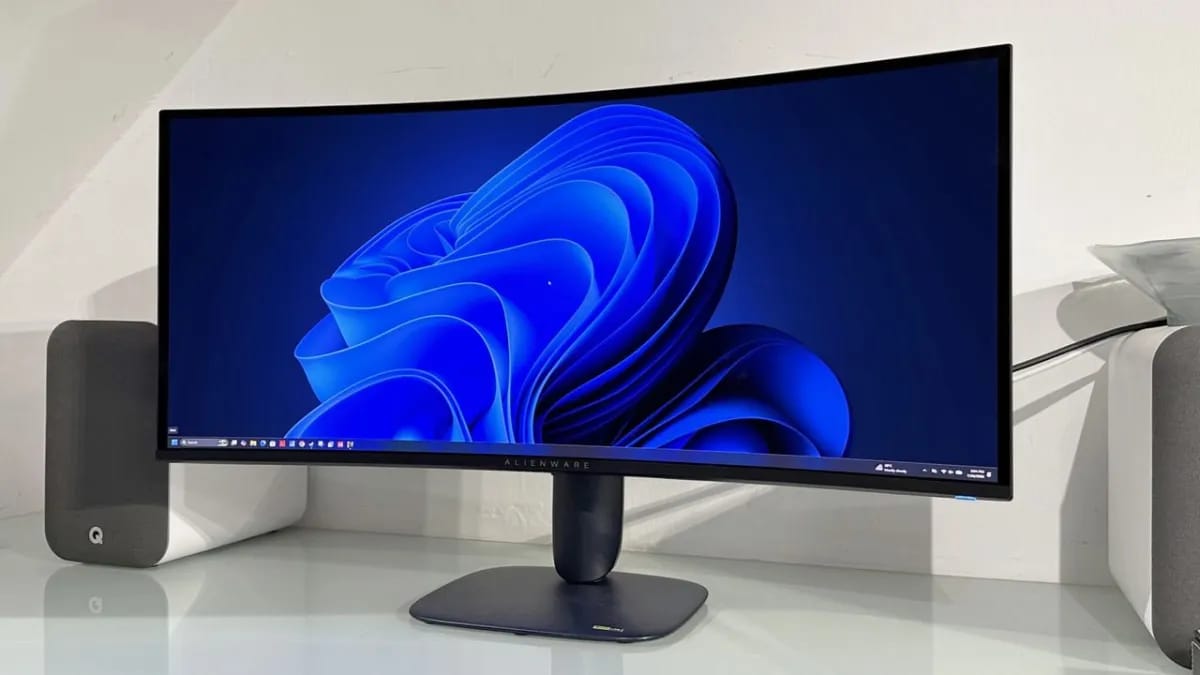
Four years after Alienware launched the AW3423DW — the monitor that effectively kicked off the mainstream OLED gaming display era — the company is back with its most substantial ultrawide update yet. The Alienware 34 AW3426DW brings Samsung's latest Penta Tandem QD-OLED panel to a 34-inch ultrawide at a $799 launch price, undercutting the competition while delivering genuinely upgraded specs across the board.
The headline numbers tell part of the story: full-screen brightness climbs from 250 nits to 300 nits, peak HDR jumps from 1,000 nits to 1,300 nits, and the VESA certification steps up from DisplayHDR True Black 400 to True Black 500. Refresh rate moves from the original 175 Hz all the way to 280 Hz — there was an interim model, the AW3425DW, that hit 240 Hz, but this is the biggest leap yet. Resolution stays at 3,440 x 1,440 with a 0.03 ms response time, and connectivity includes two HDMI 2.1 ports, DisplayPort 1.4, G-Sync support, and a USB-A/C hub. One notable omission: there is no USB-C input, which limits its appeal as a general-purpose display.
The Penta Tandem emissive layer is more than a brightness upgrade — it also improves burn-in resistance compared to earlier QD-OLED generations, and Alienware backs that with a three-year warranty that explicitly covers burn-in. The panel also switches from the triangular subpixel layout used in previous Samsung 34-inch QD-OLED panels to a standard RGB-stripe structure. That matters more than it sounds: triangular subpixels cause coloured text fringing when Windows font smoothing like ClearType is active, and at the relatively low pixel density of a 34-inch 1440p ultrawide the artefacts are hard to ignore. The RGB-stripe layout eliminates that problem. The closest rival using the same new-gen panel is the MSI MPG 341CQR QD-OLED X36, which pushes the refresh rate even higher but launched at $1,099 and currently sits at $899 — still $100 more than the Alienware.
For anyone who has been waiting to jump into QD-OLED ultrawide gaming, the AW3426DW makes a strong case as the value pick of this panel generation. The lack of USB-C is a real limitation for desk setups that rely on single-cable laptop connections, but as a dedicated gaming monitor it checks nearly every box at a price the competition hasn't matched.
Sources (1)
AI-assisted summary, reviewed by our editors — how we work.
Get the daily digest
Top gaming news in Lithuanian — every day at 9:00.