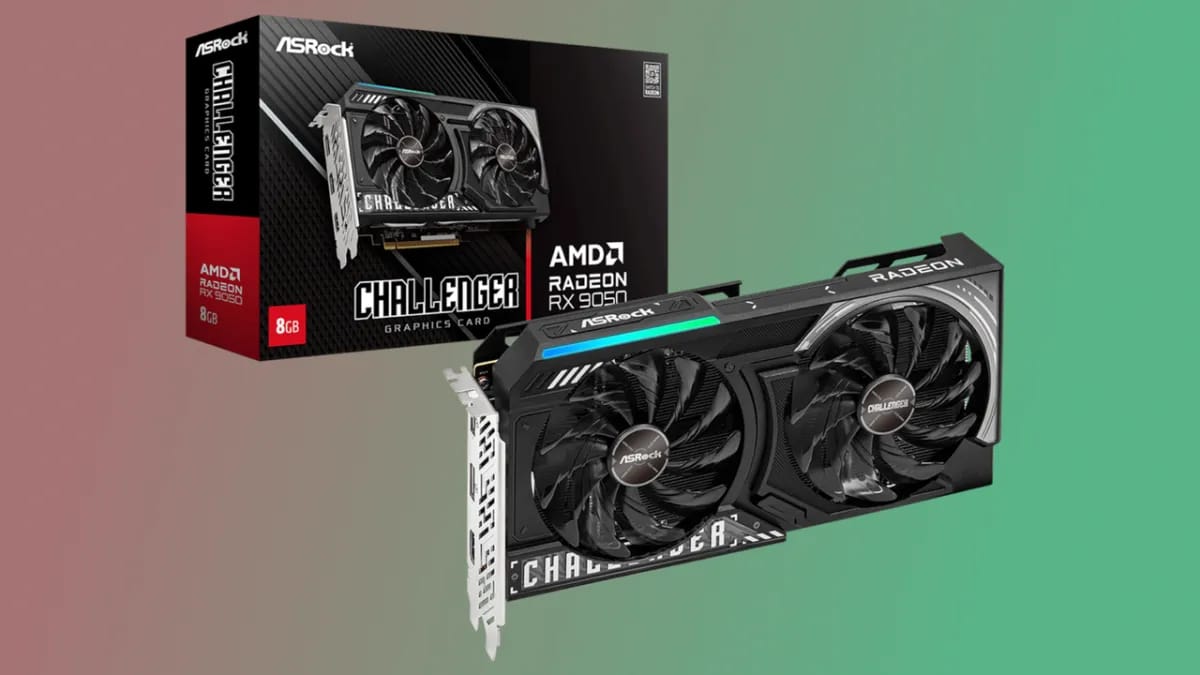
AMD has launched the RX 9050, a heavily cut-down entry-level desktop GPU starting at $279 and currently limited to LATAM and Asia Pacific regions. The first real-world review, from Japanese outlet Hermitage Akihabara, paints a rough picture — and a spec anomaly is making things murkier.
The RX 9050 uses the same Navi 44 die as the RX 9060 but with everything slashed: 16 Compute Units (1,024 cores) versus the 9060's 28 CUs (1,792 cores), a boost clock of 2,600 MHz, 8 GB of GDDR6 on a 128-bit bus, 32 MB of Infinity Cache, and a 92 W board power. That puts its rated FP32 throughput at 10.6 TFLOPs — exactly half the RX 9060's 21.4 TFLOPs. Hermitage's 3DMark testing placed the card at 4,531 in Port Royal and 1,873 in Speed Way, which hardware analyst Harukaze5719 notes is closer to RTX 3070 territory than anything newer. In real-game tests, the RX 9050 averaged 147 fps in Apex Legends at 1080p versus 192.4 fps on the RTX 5050, and 142 fps in Cyberpunk 2077 on Ultra versus 240 fps on Nvidia's card — though both figures used each card's own upscaling and frame generation, so it's not a clean comparison. Hermitage concludes the card falls short of 30 fps in some scenarios and delivers roughly 75% of the RTX 5050's performance overall. The RX 9050 does match the RTX 5050 in Rainbow Six Siege X at 4K and beats it in Doom Eternal at 1080p and 1440p with FSR, but those are the exceptions. Complicating the picture further: the reviewed ASRock unit showed only 32 ROPs in software reporting, half the 64 ROPs listed on AMD's own spec page. Fewer ROPs directly hurt rasterization throughput, and if the card genuinely shipped with half its ROPs disabled or defective, that would explain some of the weak numbers — though it could also be a software reporting bug rather than a hardware defect. Nvidia faced a similar issue with missing ROPs in some RTX 50-series cards at launch.
ASRock is the only board partner to announce retail availability so far, with its RX 9050 Challenger 8 GB model. The RX 9060, by comparison, is OEM-only outside of a single Best Buy CyberPower system priced at $890. That same CyberPower listing also surfaced an RX 9050 4 GB variant — a configuration AMD's own spec page doesn't acknowledge, though the listing describes it as a "Max Memory Size" of 8 GB, leaving room for a lower-VRAM SKU to exist quietly. AMD itself called 4 GB of VRAM "evidently not enough for today's games" back in 2022, which makes any 4 GB RX 9050 a particularly awkward product to defend in 2026. The card does carry RDNA 4's full FSR Redstone feature set, including Frame Generation and Ray Regeneration, which gives it some architectural headroom over older budget cards.
With the RTX 5050 launching at $250 and outperforming the $279 RX 9050 in most tests, AMD's value proposition here is hard to defend on paper — and that's before factoring in AMD price increase rumors that surfaced the same day as this review. More reviews from other outlets are needed before drawing firm conclusions, especially given the ROP anomaly on the tested unit, but the early signs for AMD's budget tier aren't encouraging.
Sources (2)
AI-assisted summary, reviewed by our editors — how we work.
Get the daily digest
Top gaming news in Lithuanian — every day at 9:00.