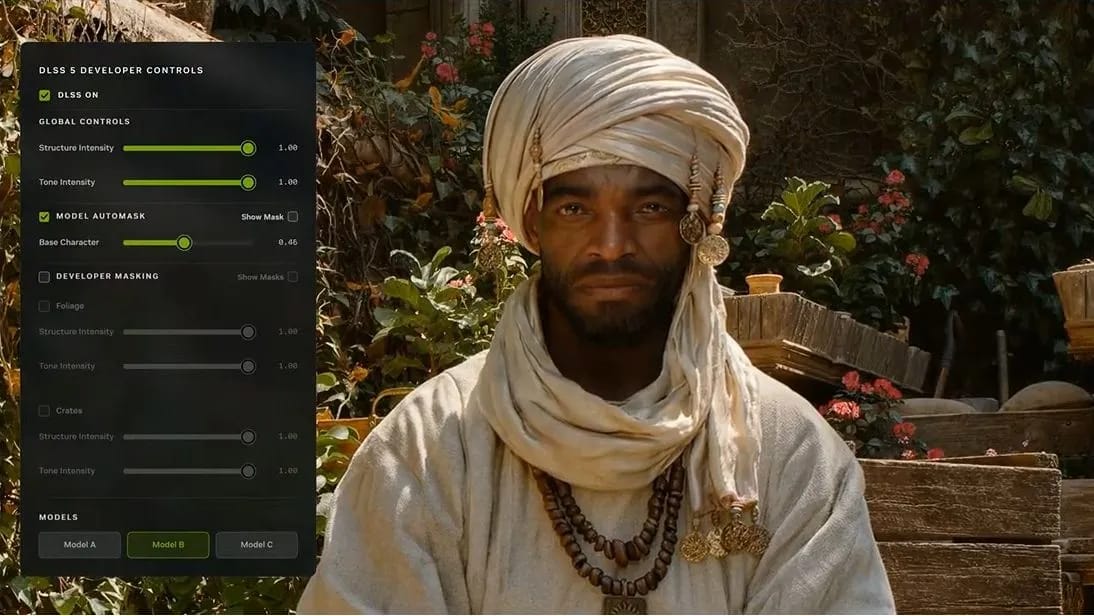
Nvidia used SIGGRAPH 2026 to finally explain what tools developers actually get to work with in DLSS 5, the AI-powered image enhancement tech announced back in March. The answer, for now, is two sliders.
The sliders control "structural intensity" and "tone intensity." Structural intensity modulates the high-frequency detail of a frame — things like ambient occlusion, subsurface scattering, and reflections. Tone intensity handles low-frequency detail, covering lighting and overall image tone. Nvidia is careful to stress that structural intensity "is not changing the geometry in any way" — it's uplifting the image, not reshaping it. Developers can also apply these sliders per-object, masking individual elements in a scene so background assets might get the full DLSS 5 treatment while characters get a lighter touch. Nvidia's creative artist, introduced as Gaff, demonstrated that nudging structural intensity up can add noticeable realism — particularly through subsurface scattering, which Gaff noted "would be incredibly expensive to do in traditional rendering." The company also confirmed more controls are in development and that it's "working with our partners to incorporate their feedback."
DLSS 5 drew a skeptical reception when Nvidia announced it in March, and for good reason — the company itself confirmed the tech works from a traditional 2D frame plus motion vectors per AI frame, which essentially validated the "AI filter" criticism that circulated after the initial demos. The new slider system doesn't dramatically change that picture. Two controls is a step up from the single on/off masking slider developers were previously thought to have, but it's still a narrow toolkit. Nvidia's argument is that the model is tuned tightly enough — using internal buffers to preserve artistic intent — that more granular controls aren't necessary. Whether that holds up in practice across wildly different art styles and genres is something studios will have to test.
Nvidia was also clear that DLSS 5 extends the existing pipeline rather than replacing it — the other AI features still in development remain separate tracks. The bigger question is whether the additional controls hinted at will actually ship when DLSS 5 launches this fall, or whether developers will be shipping games with just these two dials to work with.
Sources (1)
AI-assisted summary, reviewed by our editors — how we work.
Get the daily digest
Top gaming news in Lithuanian — every day at 9:00.