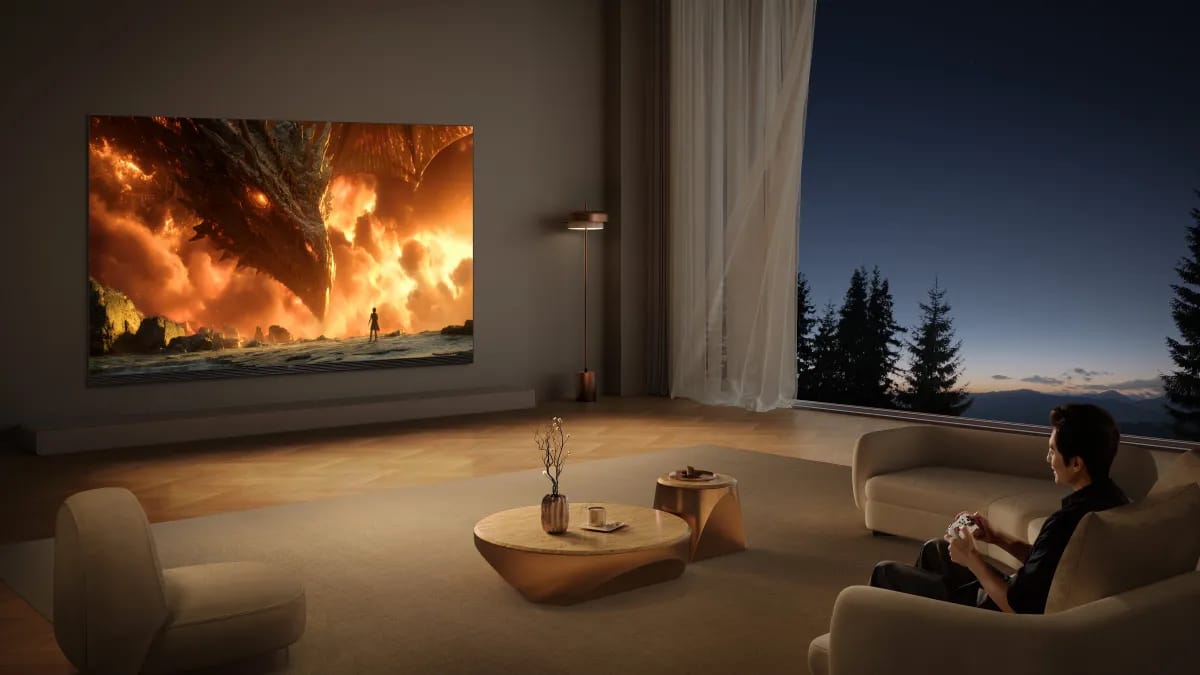
TCL's 2026 TV lineup introduces a 288Hz Game Accelerator mode across its entire range, letting competitive PC gamers ditch the desk setup without sacrificing the high refresh rates that matter in online multiplayer.
The tech behind it is called Dual Line Gate, or DLG. Normally, TCL's 2026 TVs run 4K content at 144Hz — 144 times per second, the panel draws all 2,160 lines of pixels. DLG pairs those lines up and drives them two at a time, which frees the panel to refresh twice as often. The trade-off is resolution: driving lines in pairs means only 1,080 lines get drawn, so 288Hz mode runs at 1080p rather than 4K. For competitive play, that's a reasonable swap — speed beats pixel count when you're trying to react before you get fragged. The mode is available on the flagship X11L and the SQD-Mini LED C8L and C7L, as well as the QD-Mini LED P8LS and C6L. The entry-level QLED P7LS has the underlying hardware but tops out at a lower Hz ceiling. Higher-tier models also bring better peak brightness and more dimming zones, which sharpens the contrast between blacks and colors and improves HDR performance.
The practical upside is real: TCL says every one of those 288 frames per second is a unique frame pulled from your PC — not the same image shown twice. That means input-to-screen lag is effectively halved compared to a standard 144Hz TV. Games like Valorant, Counter-Strike 2, Apex Legends, Overwatch 2, Fortnite, and Rainbow Six Siege can all push 288fps on a capable rig — something like an RTX 5070 paired with a Ryzen 7 9800X3D — and none of those frames go to waste on TCL's panels.
The pitch here is straightforward: competitive PC gaming has historically been chained to a monitor and a desk. TCL's 2026 range is the first serious attempt to move that experience to the couch without a meaningful performance penalty.
Sources (1)
AI-assisted summary, reviewed by our editors — how we work.
Get the daily digest
Top gaming news in Lithuanian — every day at 9:00.