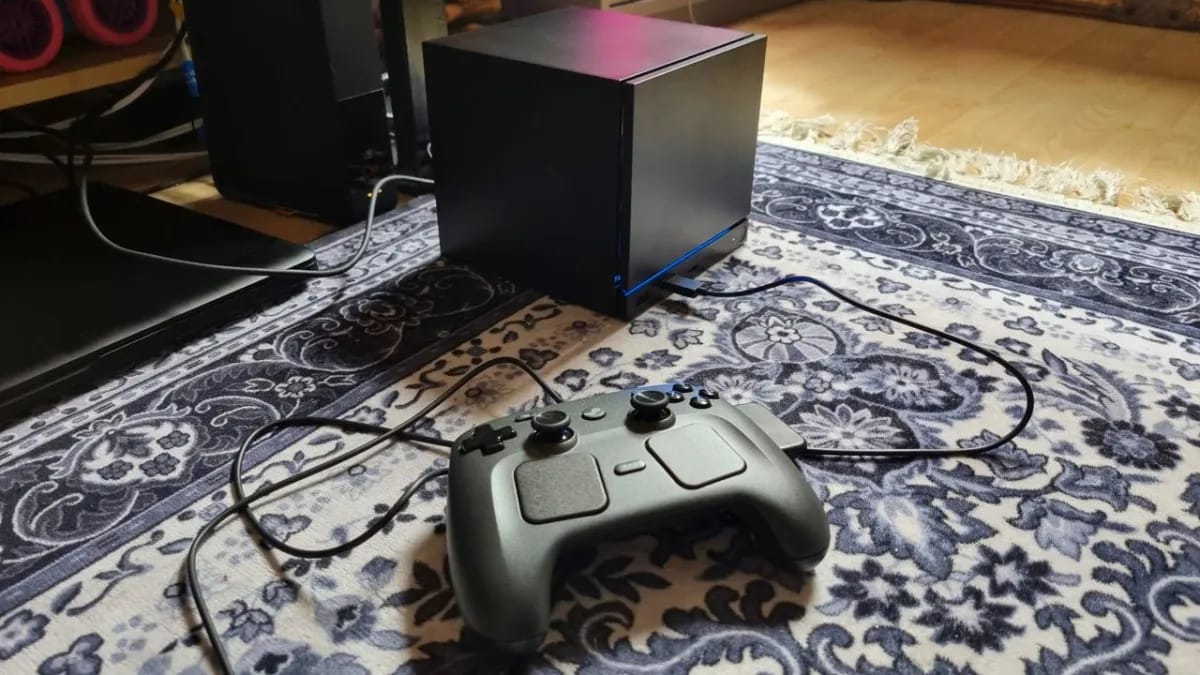
Shuhei Yoshida, former president of SIE Worldwide Studios and ex-head of PlayStation Indies, has shared his early impressions of the Steam Machine after a few hours with the hardware — and they are not glowing. His verdict on 3D performance: "meh." He also questioned why the system defaults to 1080p, joking about going back to PS4-era visuals.
Yoshida's full list of observations covers slow game boot times, a Steam Controller he finds overly sensitive on the touchpads and too loose on the sticks, and a price he calls "very unfriendly" and hard to recommend outside of research purposes. On the positive side, he praised SteamOS as a clean UI, liked the ability to wake the system via the Steam Controller, appreciated the swappable face plate, and called the small form factor and quiet operation "super good." His bottom line: "It allows me to play Steam games on my living room TV, which is a reason enough to keep it." PC Gamer's own review echoed the performance concerns, noting the Steam Machine trails even comparably priced mini PCs — the Atomman G1 Pro beat it handily — with the RDNA 3-era GPU struggling notably with ray tracing.
Meanwhile, Valve engineers Pierre-Loup Griffais and Yazan Aldehayyat told PC Gamer that the Steam Deck years essentially pre-solved most of the Steam Machine's engineering challenges. Pierre-Loup put it bluntly: "The other 99% of the work was already done in a sense." The remaining 1% was the new territory — discrete GPU integration, VRAM management, and ray tracing performance. Yazan added that Steam Deck users docking to their TVs had already proven the living-room use case before Valve formally started on the Steam Machine. The engineers describe their approach as deliberately incremental, tracing a line from the original Steam Controller through Steam Input, the Steam Deck, and now the Steam Machine. That said, the hardware is not without problems: stock issues loomed at launch, and the ongoing memory supply crisis has pushed the price higher than the team would like — "making it cheaper" sits at the top of their wish list.
As for what comes next, Valve says a Steam Machine successor won't follow the same long development cycle as the Steam Deck, but new models are "just a matter of when it makes sense." With the RAM supply crunch unlikely to ease before 2028, neither a Steam Machine 2 nor a Steam Deck follow-up looks imminent. Yoshida's lukewarm take will likely resonate with buyers weighing the price-to-performance ratio, and Valve's own engineers seem aware that the current hardware is a first step rather than a finished destination.
Sources (3)
AI-assisted summary, reviewed by our editors — how we work.
Get the daily digest
Top gaming news in Lithuanian — every day at 9:00.